Foundation Subjects
AUTUMN 1
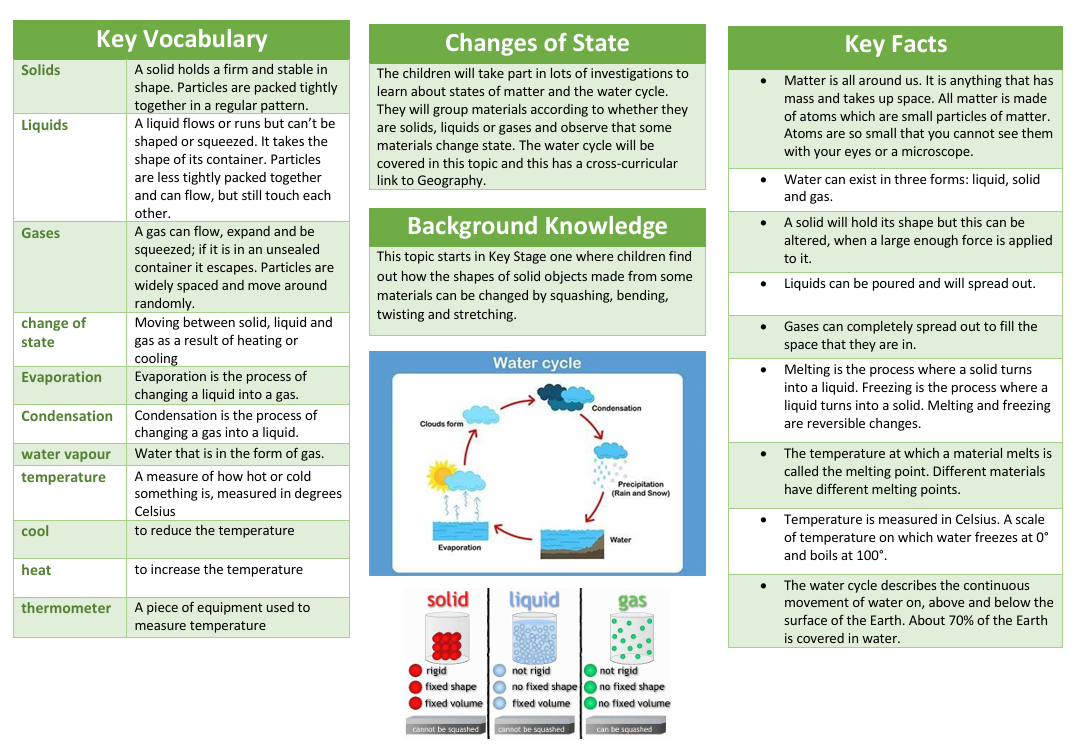
As scientists, children will learn about changes in the state of matter:

As historians, children will study about the Ancient Egyptians:
As linguists, children will learn how to present themselves in French:
As computer technicians, children will learn to use Logo programming, focusing on developing their understanding of basic commands and programming concepts. Children will learn to create shapes and letters using instructions that contain advanced features such as procedures.

The 2nd computing unit (Sound Stories) introduces children to an audio recording tool in Purple Mash. Children will explore the features of effective audio books and work as a team to script, record and edit their own.

As artists, children will be studying recycled art. They will explore different ways of joining materials. They will explore the texture and appearance of different junk materials to generate ideas inspired by their properties. They will create a simple animal sculpture, a piece of 3D art from recycled cardboard and finally a piece of art to convey a message.


In PSHE, children will study the unit: Me and My Relationships. They will learn to:
- Define the successful qualities of teamwork and collaboration;
- Listen to and respect different ideas;
- Demonstrate positive negotiation and collaboration with others.
- Explain what we mean by a positive, healthy relationship;
- Describe some of the qualities that they admire in others;
- Recognise when a friendship is making them feel unsafe, unhappy, or uncomfortable:
- Explain how to manage difficult feelings, and when to ask for help if needed.
- Recognise that there are times when they might need to say 'no' to a friend;
- Describe appropriate assertive strategies for saying 'no' to a friend;
- Recognise the importance of respecting the needs and feelings of others.
- Identify and describe a range of feelings;
- Recognise that feelings can range in intensity and change over time;
- Explain how feelings can affect our physical state;
- Describe a range of strategies for managing uncomfortable feelings, including when and how to seek help.
- Recognise that different people can have different feelings in the same situation and these might be expressed in different ways.
- Recognise behaviours that could make someone feel unsafe, unhappy, or uncomfortable, including online;
- Explain why people may behave in unkind ways, and where pressure to behave in a risky way might come from;
- Give examples of strategies to respond to being bullied, including what people can do and say;
- Describe how to seek help for themselves and others.
As musicians, children will start copying rhythmic patterns and performing together. They will learn to follow musical instructions and experience how it feels to be the conductor! Throughout the term, the children will develop their knowledge of rhythmic notation and use movement to express these concepts. They will have fun exploring songs such as Harvest Samba and will learn how music can be built by combining layers of rhythm. Developing ensemble skills is a key focus and the children will learn to stick to their own part in a group as well as thinking about ways to improve their group performances. The term ends with children composing music within a rhythmic framework with a selection of activities to choose from – the children could write new lyrics to a song, explore rhythm grid notation or create a class composition using rhythmic motifs.
In RE, children will study: What do different people believe about God?